

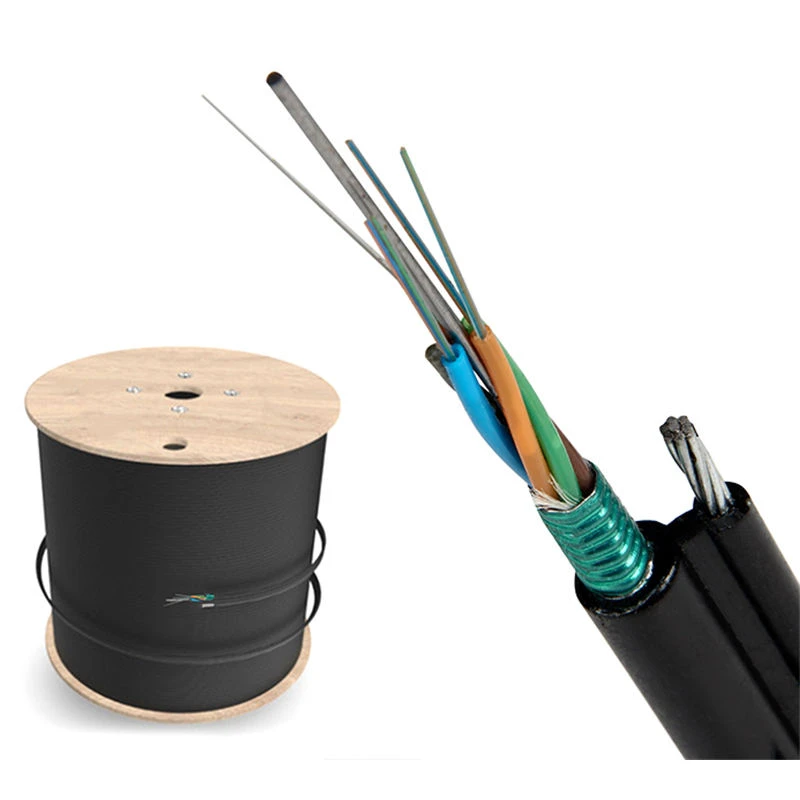


Self-Supporting Armored Fiber Optic Cable
Product Description
The Self-Supporting Armored Fiber Optic Cable is built for one job: being strung pole-to-pole across the open sky without any separate support strand, lashing wire, or messenger line. Its defining feature is an integrated strength member that lets the cable carry its own weight and tension.
Two construction families deliver this capability. The figure-8 type combines a loose-tube, steel-tape-armored fiber core with a steel stranded messenger joined in the familiar "8" cross-section - the messenger does the heavy lifting while the optical unit rides protected beside it. The ADSS (All-Dielectric Self-Supporting) type replaces the steel messenger with aramid yarn strength members and a non-metallic armor, making the whole assembly dielectric and immune to lightning and induction.
Both versions are armored for the outside environment - corrugated steel tape or a dielectric jacket system shields the fibers from rodents, impact, and weather. The result is a single-pass aerial line: a crew strings it once, tensioned on its own messenger, and the fiber path is live.
Product Applications
Long-haul and metro-access aerial backbones strung directly between utility poles, eliminating the cost of a separate messenger strand.
Last-mile FTTx and rural broadband extensions where trenching is impossible or uneconomical and overhead routing is the only practical path.
Power utility and railway corridor communications, where ADSS all-dielectric versions run safely alongside energized lines without risk of short circuits.
Campus and industrial site inter-building links spanning open yards, car parks, and right-of-way gaps too wide for duct burial.
Temporary or rapid-deployment networks - disaster recovery, events, and construction sites that need fiber up fast and taken down just as easily.
Product Advantages
Integrated messenger means one product and one pass - no lashing wire or support strand to procure, haul, and tension.
Long unsupported spans reduce the number of poles and attachment points needed, lowering both material and labor cost per kilometer.
Armored construction protects the fiber core from rodent attack, mechanical impact, and UV-driven jacket degradation over a 20+ year service life.
ADSS dielectric option eliminates lightning and induction risk, ideal for co-location on power structures and lightning-prone regions.
Stable performance through wind, ice, and thermal swing thanks to a messenger sized to the route's load and a balanced figure-8 geometry.
Compact figure-8 profile simplifies reel handling and stringing versus a cable plus a standalone messenger in two operations.
Key attributes
|
Brand Name |
Sheng Tang |
Model Number |
Gyxtc8S |
|
Type |
Fiber Optic Cable |
Place of Origin |
Guangdong, China |
|
Number of Conductors |
≥ 10 |
Loose tube |
PBT |
|
Number of C |
≥ 10 |
Fiber Type |
single mode/multimode |
|
Sheath |
PE /AT |
Fiber count |
2-288 |
|
MOQ |
2000Meter/Meters |
Application |
Telecommunication, Aerial, Duct |
|
Port |
GUANGZHOU |
Place of Origin |
Guangdong, China (Mainland) |
Packaging and delivery
| Packaging Details | Gyxtc8S fiber optic cable's packing way: wooden drum or wooden iron drum 1000 m to 3000 m per drum, or any length size as customer required. | Port of dispatch | GUANGZHOU, SHENZHEN |
| Selling Units | Single item | Single package size | 20X25X10 cm |
| Single gross weight | 2.000 kg | Packaging examples |  |
Supply capacity
| Supply Ability | 10000 kilograms per Month |
Lead time
| Quantity (meters) | 1 - 100 | 101 - 1000 | 1001-10000 | > 10000 |
| Lead time (days) | 8 | 20 | 35 | To be negotiated |
Customization options
| Option | Min. order: | Customization fee |
|
Customized logo As requested |
1000 meters | -- |
|
Customized packaging As requested |
1000 meters | -- |
|
Graphic customization As requested |
1000 meters | -- |


Company Information

Packaging & Shipping

FAQ
Q1: Should I choose the figure-8 steel-messenger type or the ADSS all-dielectric type?
It depends on the structure. If you are stringing between standard telecom poles and want maximum tensile economy, the figure-8 steel-messenger cable is the workhorse. Choose ADSS when the route runs along power poles or energized corridors - its all-dielectric build removes any galvanic or lightning hazard and needs no grounding.
Q2: What span length and pole spacing can this cable cover, and how do I size the messenger?
Typical figure-8 spans run 50–150 meters between poles, with ADSS reaching 100–300 meters or more when specified. Messenger sizing follows the route: we calculate required tensile strength from span length, ice and wind load, and a safety factor, then match the steel strand diameter or aramid count accordingly.
Q3: Doesn't the armor add weight that overloads the poles?
Armor does add mass, but it is modest - corrugated steel tape or a thin dielectric shield adds a small fraction versus the fiber core itself. The dominant load is the messenger and its tension. We verify pole class and allowable vertical load against the utility's attachment rules and reduce the span or upsize the messenger where limits are tight.
Q4: How do wind, ice, and cable galloping affect a self-supporting aerial line?
Wind induces sway and, at certain speeds, Aeolian vibration or galloping that fatigues fittings, while ice adds vertical load and wind capture. We specify by wind zone and ice-thickness rating, adding dampers or helical ties where galloping is expected.
Q5: What attachment hardware is needed, and can it go up without a separate messenger wire?
You need dead-end clamps at each termination, suspension or tangent clamps at intermediate poles, and brackets or bolts for the pole face. Crucially, because the messenger is built in, no separate messenger wire is required - the dead-ends grip the integrated strength member directly, making this a true one-product aerial build.