


Product Data Sheet: Direct-Buried Communication Fiber Optic Cable
Product Overview
Direct-Buried Communication Fiber Optic Cable is a ruggedized outdoor transmission medium engineered specifically for permanent underground installation without the need for protective conduits. Designed with a steel tape armoring layer and a high-density polyethylene (HDPE) outer sheath, this cable provides superior mechanical protection against soil沉降, rodent bites, and accidental excavation strikes. It is the industry standard for long-haul backbone networks, metropolitan area networks (MANs), and FTTx distribution links where trenching is the primary deployment method.
Construction & Design Features
Central Strength Member (FRP or Steel): Provides tensile rigidity to prevent fiber strain during pulling operations.
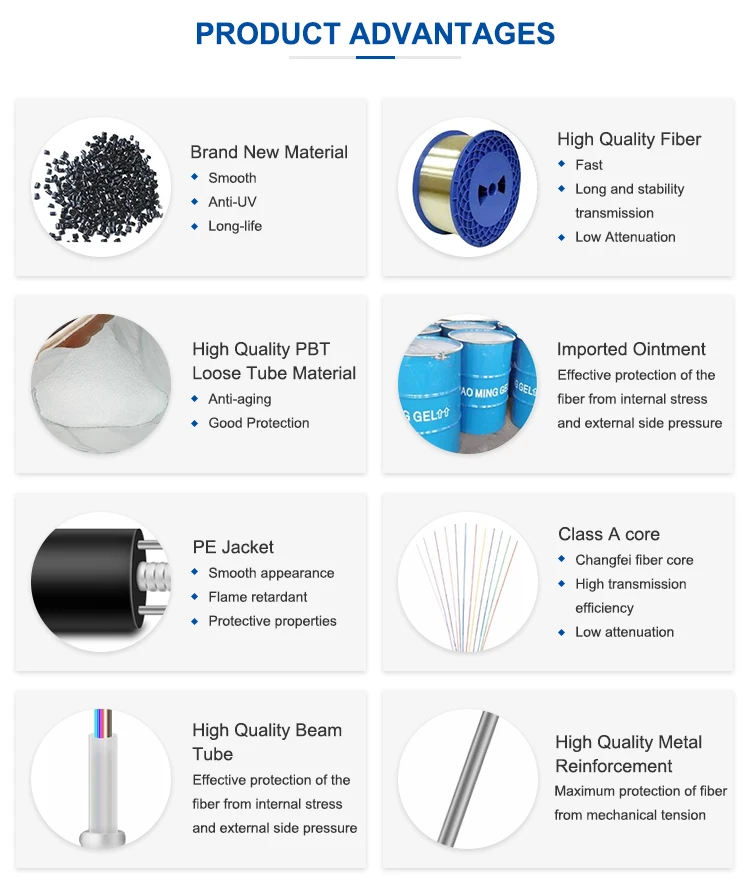
Loose Tube Filling: Optical fibers are housed in PBT (polybutylene terephthalate) loose tubes filled with water-blocking gel or dry water-swellable tape to protect against moisture ingress.
Armoring Layer: Corrugated or flat steel tape armor (0.15–0.25mm thickness) wrapped longitudinally to resist radial pressure and rodent gnawing.
Outer Sheath: Black UV-resistant HDPE sheath with a minimum thickness of 1.8mm, offering exceptional abrasion resistance and environmental stress crack resistance.
Water Blocking: Comprehensive dry-core or flooding compound technology ensures zero water penetration even if the outer sheath is compromised.
Key Technical Specifications
Fiber Count: 2 to 288 cores (SM G.652D / G.657A1 or MM OM3/OM4).
Attenuation: ≤0.36 dB/km @ 1310nm; ≤0.22 dB/km @ 1550nm.
Crush Resistance: ≥3000 N/100mm (superior to standard duct cables).
Impact Resistance: Withstands 5 impacts of 20N·m without fiber attenuation change.
Storage/Operating Temperature: -40°C to +70°C.
Application Advantages
Direct Earth Burial: Eliminates the high cost of PVC conduits and concrete encasement, reducing material and labor expenses by up to 30% compared to ducted installations.
Superior Mechanical Protection: The steel tape armor acts as a formidable barrier against backfill rocks, heavy compaction equipment, and rodent attacks, ensuring a service life exceeding 30 years under standard soil conditions.
Excellent Moisture and Chemical Resistance: The HDPE sheath and water-blocking compounds resist acidic/alkaline soil corrosion, hydrogen sulfide, and groundwater infiltration, maintaining stable transmission performance in flood-prone areas.
High Tensile Strength: Withstands pulling tensions up to 3000N during plowing or trenchless installation, facilitating long-span deployments between access points.
Minimal Maintenance: The robust construction reduces outage risks from external forces, making it ideal for military, railway, and highway communication backbones where reliability is non-negotiable.
Thermal Stability: Wide operating temperature range ensures low-temperature bending and high-temperature expansion do not affect micro-bending loss, enabling deployment in desert or permafrost regions.
Recommended Applications
Inter-city trunk lines and provincial backbone networks.
Industrial campuses and smart grid power communication systems.
Railway signaling and highway intelligent transportation systems (ITS).
Oil & gas pipeline supervisory control and data acquisition (SCADA) links.
Rural broadband FTTx distribution where aerial routes are unavailable.
Key attributes
|
Brand Name |
Sheng Tang |
Model Number |
Gyty53 |
|
Type |
Outdoor Fiber Optic Cable |
Place of Origin |
Guangdong, China |
|
Number of Conductors |
≥ 10 |
Loose tube | PBT |
| Number of C | ≥ 10 | Fiber Type | single mode/multimode |
| Sheath | PE /AT | Fiber count | 2-288 |
|
MOQ |
2000Meter/Meters |
Application |
Telecommunication,Aerial,Duct |
| Port |
GUANGZHOU |
Place of Origin |
Guangdong, China (Mainland) |
Packaging and delivery
| Selling Units | Single item | Single package size | 20X25X10 cm |
| Single gross weight | 2.000 kg |
Lead time
| Quantity (meters) | 1 - 3000 | 3001 - 60000 | 60001 - 900000 | > 900000 |
| Lead time (days) | 4 | 8 | 15 | To be negotiated |

Company Information

Packaging & Shipping

FAQ
Q1: What is the maximum burial depth recommended for this direct-buried cable?
A: The standard recommended burial depth is 0.8 to 1.2 meters (2.6–4 feet) below ground level, depending on local frost lines. In agricultural or plowed fields, we recommend a minimum of 1.0 meter to avoid accidental damage from farming implements. For road crossings, the cable should be installed inside a steel pipe at 1.5 meters depth for additional protection.
Q2: Can this cable be directly connected to a joint closure underground?
A: Yes. This cable is compatible with standard underground joint closures (in-line or butt-type). However, you must use heat-shrinkable sleeves and mechanical seals rated for direct-burial environments. We strongly recommend placing the closure in a small concrete pit or handhole for easy future maintenance, although direct burial of closures is also permissible with proper waterproofing.
Q3: How does the steel tape armor affect the bending radius during installation?
A: The steel armor increases the cable's minimum bending radius. For installation, the dynamic bending radius should be at least 20 times the cable diameter (e.g., 400mm for a 20mm cable), while the static (in-service) radius can be reduced to 10 times the diameter. Exceeding these limits can cause permanent kinking of the armor and increased micro-bending loss.
Q4: Is this cable suitable for trenchless directional drilling?
A: Yes, but with precautions. For HDD (Horizontal Directional Drilling) installations exceeding 200 meters, we recommend using an enhanced version with extra tensile strength members and a smooth outer sheath lubricant. The standard direct-burial cable can handle short HDD pulls (<150m) but is primarily optimized for open-trench plowing and manual laying.
Q5: What is the standard delivery length and how is termination prepared?
A: Standard delivery lengths are 2,000 or 4,000 meters per reel (customizable upon request). For termination, you must strip back the HDPE sheath and steel armor using a rotary cable stripper. We provide detailed termination kits including armor grounding clamps to safely divert induced electrical currents from the steel tape, ensuring no damage to the optical fibers inside the loose tubes.