


Armored Outdoor Fiber Optic Cable
Product Description
Selecting protected cable for outside-plant work should start with the hazard, not the hardware. Every route carries a dominant threat - rodents, traffic, aerial tension, or coastal corrosion - and the move is to match it with the correct armor layer. Armored Outdoor Fiber Optic Cable is the umbrella category that lets specifiers choose the right shielded construction per site.
The logic is simple. Where gnawing animals and termites dominate, corrugated steel tape intercepts teeth before they reach the buffer tubes. Where cables sit under roads or deep backfill, steel-wire armor (SWA) absorbs crush and load tape cannot. Spans between poles use a steel messenger or aramid-reinforced all-dielectric (ADSS) design for span tension without a separate strand. Along coastlines, aluminium-tape or fully dielectric armor resists corrosion and removes magnetic interaction. Read the site first.
Product Applications
Direct-buried campus and edge links across lawns and landscaped zones where rodents and moles are active
Roadway and railway crossings where traffic and deep backfill demand crush-resistant steel-wire armoring
Aerial distribution along poles and between buildings, via messenger or ADSS aramid-reinforced self-supporting constructions
Coastal, harbor, and industrial sites exposed to salt fog and chemical corrosion, favoring aluminium-tape or non-metallic protection
Telecom, power, and enterprise outside-plant runs that stay serviceable through flooding, excavation, and wildlife exposure
Product Advantages
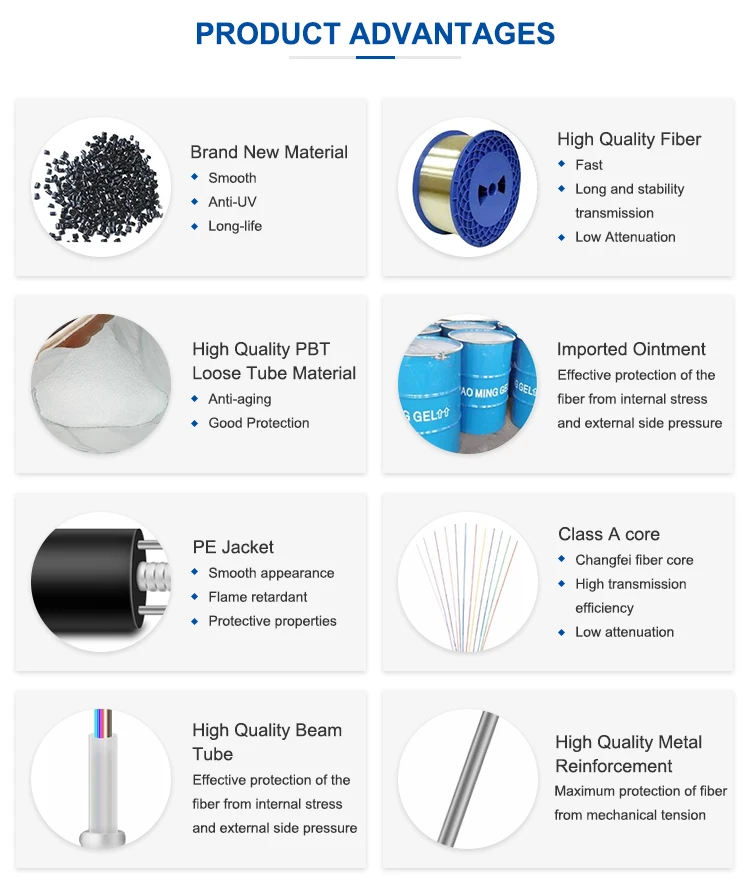
Threat-matched armoring prevents the two classic failures - gnaw-through and crush-collapse - placing the right shield where risk lives
Steel-tape layers deliver light weight and low cost for rodent-prone, low-load routes, keeping the bill of materials lean
Steel-wire (SWA) builds add load-bearing strength for direct burial under traffic without sacrificing bend handling on installation
Aerial variants carry span tension, cutting pole hardware and repeat visits on overhead runs
Aluminium-tape and all-dielectric options remove magnetic interference and corrosion pathways in coastal, high-frequency sites
A common loose- or central-tube core across the family simplifies splicing, stocking, and crew training regardless of armor
Key attributes
|
Brand Name |
Sheng Tang |
Model Number |
Gyty53 |
|
Type |
Outdoor Fiber Optic Cable |
Place of Origin |
Guangdong, China |
|
Number of Conductors |
≥ 10 |
Loose tube | PBT |
| Number of C | ≥ 10 | Fiber Type | single mode/multimode |
| Sheath | PE /AT | Fiber count | 2-288 |
|
MOQ |
2000Meter/Meters |
Application |
Telecommunication,Aerial,Duct |
| Port |
GUANGZHOU |
Place of Origin |
Guangdong, China (Mainland) |
Packaging and delivery
| Selling Units | Single item | Single package size | 20X25X10 cm |
| Single gross weight | 2.000 kg |
Lead time
| Quantity (meters) | 1 - 3000 | 3001 - 60000 | 60001 - 900000 | > 900000 |
| Lead time (days) | 4 | 8 | 15 | To be negotiated |
Customization options
| Option | Min. order: | Customization fee |
|
Customized logo As requested |
1000 meters | -- |
|
Customized packaging As requested |
1000 meters | -- |
|
Graphic customization As requested |
1000 meters | -- |

Company Information

Packaging & Shipping

FAQ
Q1: For outdoor projects, which armor type fits which threat? Read the dominant hazard first. Rodent and termite gnawing calls for corrugated steel tape. Heavy crush, traffic, and backfill call for steel-wire armor (SWA). Aerial span tension is handled by a steel messenger or aramid-reinforced all-dielectric (ADSS) design. Coastal and non-magnetic needs point to aluminium-tape or dielectric armor. Match the shield to the threat.
Q2: Steel-wire armor (SWA) vs steel-tape armor (STA) for outdoor use - when to choose which, and how do weight and tensile capacity differ? Choose STA on gnaw-prone routes with little compression - lighter, cheaper, easier to handle. Choose SWA where buried under roads, rail, or heavy backfill; the helical wires add crush resistance and higher tension during pull-in. Expect SWA heavier and stiffer, paying back in load survival. Tape suits low-load protection; wire suits load-bearing protection.
Q3: Does the armor layer affect fiber bend performance and splice slack during termination - what should field crews watch for when ending-in an armored cable? Yes. The armor adds stiffness, so respect the cable's minimum bend radius and avoid tight coils near the breakout. Leave generous splice slack, because the armor cannot bend as sharply as the fibers it protects. When cutting back, deburr and protect the core with a breakout kit.
Q4: In sites needing non-magnetic behavior or near high-frequency equipment / lightning-prone areas, why pick aluminium-tape or all-dielectric armor instead of steel? Steel conducts and can couple with magnetic fields, eddy currents, and lightning paths, creating interference near gear. Aluminium tape reduces magnetic interaction while offering a corrosion-resistant shield, and fully dielectric (aramid/FRP) armor removes metal entirely. The trade-off is less mechanical bite than steel, so pair dielectric armor with careful routing.
Q5: How is the armor layer itself terminated and grounded at splice closures and building entry, and how is the indoor segment handled after the armored outdoor run? At splice closures the metal armor is cut back, elements are fanned into the tray, and any steel or aluminium layer is bonded to the ground bus to dissipate fault currents. At building entry the armored run becomes a non-armored indoor cable through a sealed grounding termination keeping the outdoor shield outside the building. This limits lightning and moisture ingress while meeting indoor fire codes.