

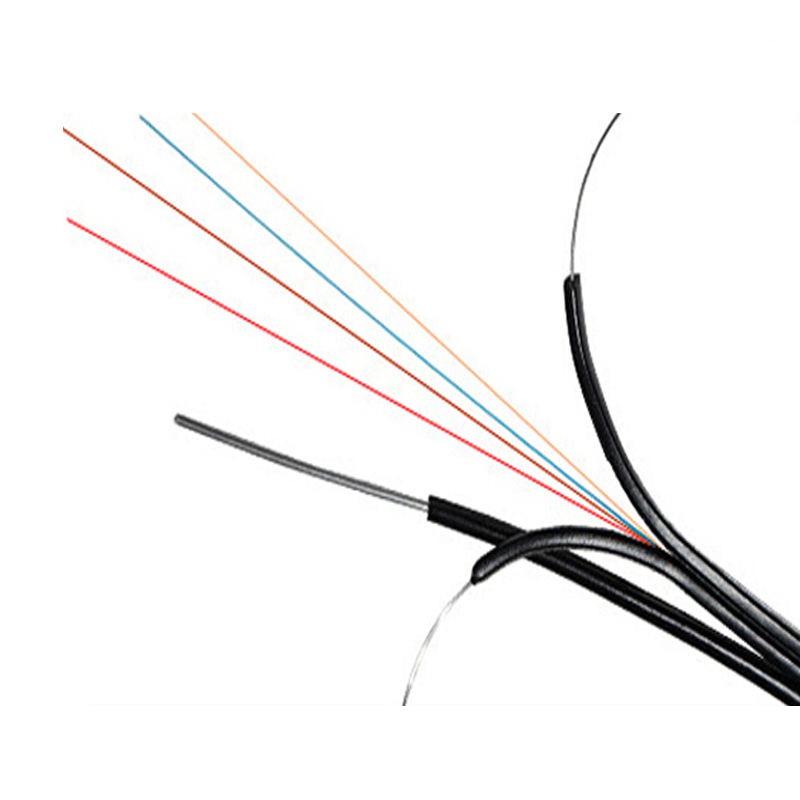
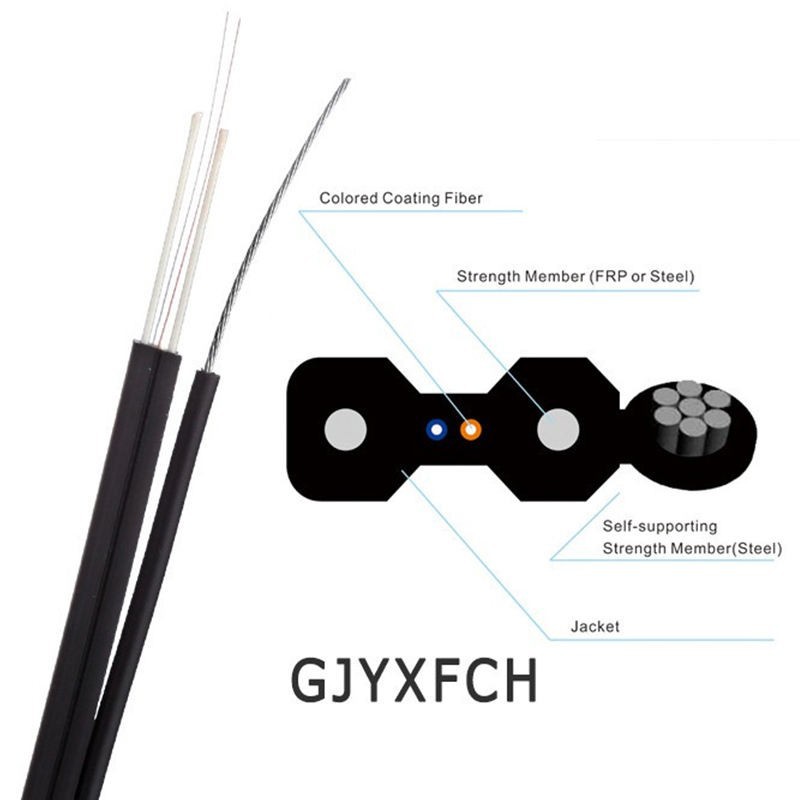
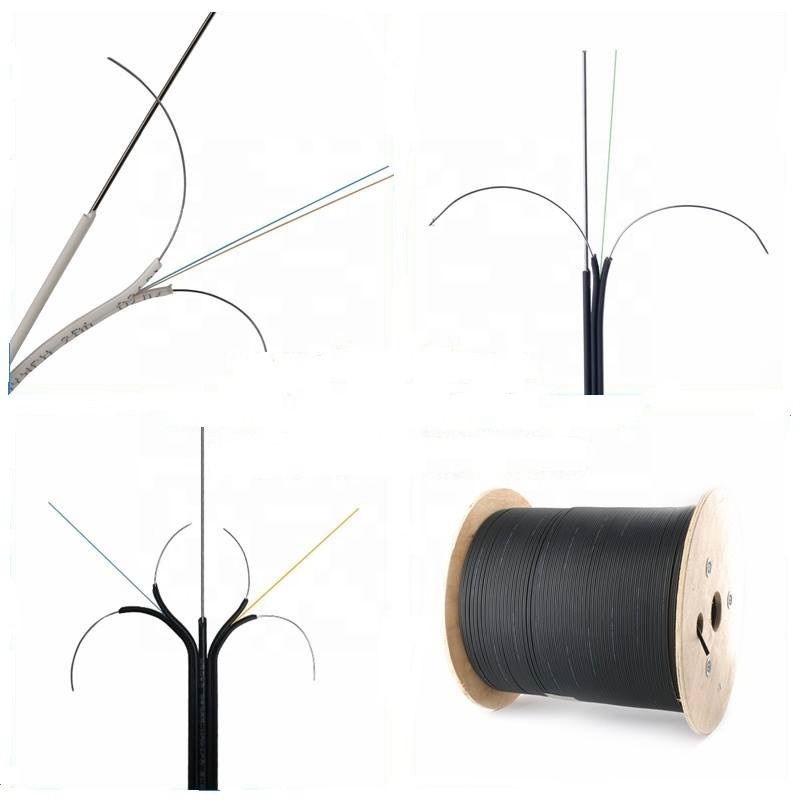

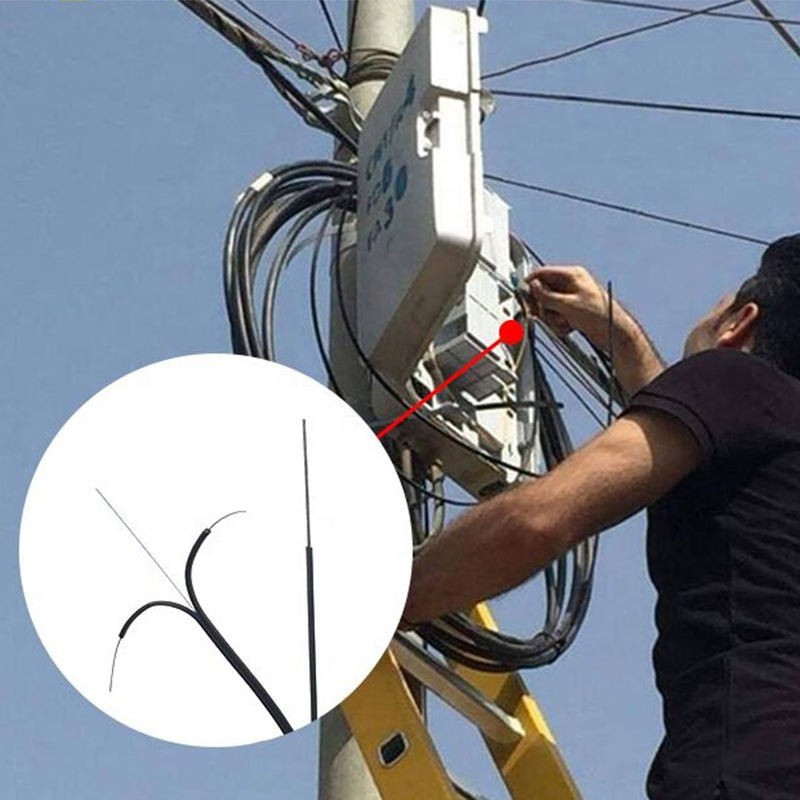
FTTH Fiber Optic Cable
FTTH (Fiber To The Home) Fiber Optic Cable is the transmission medium of the optical distribution network, or ODN, that carries broadband signals from the central office all the way to the subscriber's residence. In a point-to-multipoint architecture, one port on the OLT feeds a passive optical splitter, and individual fibers radiate outward from that splitter to dozens of homes. The cable makes this fan-out physically possible, bundling, routing, and protecting every fiber path across poles, ducts, walls, and risers until the light reaches the ONU inside the home.
Because the network is fully passive between the two active endpoints, FTTH cable must deliver stable optical performance over spans of up to twenty kilometers while surviving the mechanical abuse of real-world deployment. Splitting ratios of 1:32 or 1:64 divide the optical budget among many subscribers, so every decibel of loss in the cable matters - well-manufactured cable keeps attenuation low and consistent, letting the planner budget accurately and the operator serve the maximum number of homes from one OLT port.
Applications
New residential estates: Cable is laid during construction, buried or drawn through conduit, so every home is lit from day one with no re-cabling later.
Urban renewal areas: Dense city districts being redeveloped for gigabit services use FTTH cable through existing duct banks and new overhead routes alike.
Rural and suburban coverage: Long aerial runs and mixed pole-to-house routes carry the final drop segment to homes in scattered communities.
Multi-dwelling buildings: Riser cables bring fiber to each floor, where splitters distribute individual fibers to apartments through short in-building drops.
Business and campus estates: The same cable serves offices and workshops, giving commercial tenants symmetrical services over a shared PON.
FTTB and FTTC hybrid scenarios: Where full home penetration is deferred, cable reaches basements or curbside cabinets, leaving a clear upgrade path to full home delivery.
Advantages
Massive, upgradeable bandwidth: A single fiber pair supports gigabit plans and future higher-rate generations, so the cable never becomes the bottleneck.
Long reach without regeneration: Low attenuation over long budgets removes the need for intermediate amplifiers or powered cabinets along most routes.
Full immunity to electromagnetic interference: Glass carries light rather than current, so proximity to power lines and radio sources does not degrade the signal.
No powered equipment in the field: The passive ODN consumes no electricity between the exchange and the home, cutting operating cost and eliminating outdoor electronics failures.
Minimal maintenance burden: With no copper pairs to corrode or suffer induced noise, fault rates stay low and repairs are localized and fast.
Superior longevity: Fiber does not oxidize or fatigue under normal service, so the installed plant keeps its value across decades of technology refreshes.
Symmetric service capability: Unlike asymmetric copper, FTTH delivers equal upload and download rates, supporting cloud backup and live streaming without compromise.
Flexible architecture: Splitting ratios and fiber counts are chosen per project, and wavelength multiplexing later adds capacity without touching the cable.
Key Attributes
|
Brand Name |
Shen Tang |
Model Number |
FTTH Drop Fiber Optic Cable GJYXCH GJXH |
|
Type |
Fiber Optic Cable |
Place of Origin |
Guangdong, China |
|
Number of Conductors |
2 |
Colour |
black |
|
Model Number |
FTTH Drop Fiber Optic Cable GJYXCH GJXH |
Fiber |
G652D/G657A1/G657A2 |
|
Fiber Type |
SM/MM/OM3 |
Strength member |
phosphated steel wire |
|
Brand Name |
OEM |
Product name |
Fiber Optic Cable 4 Core |
|
Jacket Material |
LSZH |
Port |
GUANGZHOU |
Packaging and delivery
| Selling Units | Single item |
Lead time
| Quantity (meters) | 1 - 1000 | 1001 - 50000 | 50001 - 300000 | > 300000 |
| Lead time (days) | 7 | 12 | 25 | To be negotiated |
Customization options
| Option | Min. order: | Customization fee |
|
Customized logo As requested |
2000 meters | -- |
|
Customized packaging As requested |
2000 meters | -- |
|
Graphic customization As requested |
2000 meters | -- |


Company Information

Packaging & Shipping

FAQ
Q1: What role does the cable play inside an FTTH network?
It is the physical path of the ODN, connecting the splitter and the subscriber's ONU. Every home needs a dedicated fiber strand, and the cable organizes, routes, and protects those strands from the distribution point to the living space.
Q2: How many subscribers can one cable serve?
It depends on the splitting ratio and fiber count. A 1:32 splitter with a 32-core distribution cable lights 32 homes; with 1:64 splitting and 64-core cable, one OLT port can reach 64 subscribers. Higher counts simply add fibers, not electronics.
Q3: How far can the signal travel?
Standard PON designs cover a logical reach of about twenty kilometers from the OLT. Within that radius, the cable introduces only a fraction of the total link loss, leaving most of the optical budget for the splitter and connectors.
Q4: Will the cable support future speed upgrades?
Yes. The fiber carries far more capacity than current transceivers use, and operators migrate to faster PON generations or add wavelengths on the same fiber, so the installed cable remains in service without replacement.
Q5: Which cable type should a project choose?
Match the product to the network segment: armored or self-supporting drop cable for aerial and buried runs, distribution cable for risers, and indoor bow-shaped drop cable for the final stretch into the home. A consistent family simplifies ordering.
Available in outdoor, aerial, and indoor variants with fiber counts from 1 to 96 and lengths matched to route surveys. Sheath types, strength members, and printing can be specified per project, and samples with test records are provided on request.